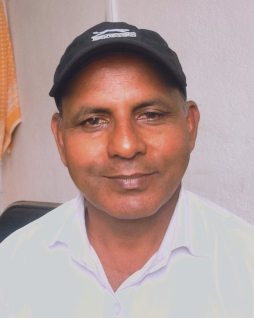
Dr. Anuj Bhattachan

Dr. Anuj Bhattachan

Director

Epidemiology And Disease Control Division

  • M.B.B.S., M.P.H.
Dr. Pomawati Thapa

Dr. Pomawati Thapa

Sr. Consultant Med. Generalist

Non-communicable Disease And Mental Health Section

  • MBBS, MS
Dr. Gokarna Dahal

Dr. Gokarna Dahal

Section Chief

NTD And Vector Borne Disease Control Section

  • BAMS, MPH, MPA
Nistha Shrestha

Nistha Shrestha

Co Chief (10th Level)

Leprosy Control & Disability Management Section, EDCD

  • Physiotherapist
Hem Raj Pandey

Hem Raj Pandey

Section Chief

Disease Surveillance & Research Section, EDCD

  • Masters in Science (Epidemiology)
Dr. Shashi Kandel

Dr. Shashi Kandel

Medical Officer

Epidemiology & Disease Control Division (EDCD)

  • MBBS, Master's in Science (Epidemiology), Advanced FETP
Ram Chandra Chaulagain

Ram Chandra Chaulagain

Statistics Officer

Disease Surveillance & Research Section, EDCD

  • Masters in Economics
Ram Kumar Mahato

Ram Kumar Mahato

Senior Public Health Officer

Epidemiology And Disease Control Division (EDCD)

  • Master of Public Health
Anil K.C.

Anil K.C.

Senior Public Health Officer

Non-communicable Disease And Mental Health Section

  • BPH, MPH
Bihari Mahato

Bihari Mahato

Veterinary Officer

Epidemiology And Disease Control Division

  • Bachelor in Animal Science

News & Update

Jan 1

Post-disaster communicable disease surveillance and response plan

Flooding in the rural districts of Bagmati Province creates the classic postdisaster conditions for communicable disease transmission: contamination of drinking-water sources, destruction of latrines, displacement of populations into crowded temporary shelters, interruption of health services and cold chain, expansion of vector breeding habitat, and loss of livestock with associated zoonotic exposure. Floods do not import new pathogens; they amplify the pathogens already endemic in the area. Preparedness must therefore be built on what is known to circulate in Bagmati Province — including the enteric pathogens Vibrio cholerae O1, Salmonella Typhi and hepatitis A and E viruses, together with dengue virus, Orientia tsutsugamushi, Leptospira species, Japanese encephalitis virus, measles virus, and residual foci of malaria and visceral leishmaniasis. Two operational realities shape this plan. First, the interval between exposure and detectable clusters is short for enteric disease (2–14 days) and long for vector-borne and leptospiral disease (2–8 weeks), so surveillance intensity must be sustained well beyond the point at which media and political attention recede. Second, the routine surveillance system will be degraded exactly when it is most needed, because reporting health facilities may be damaged, staff displaced and connectivity lost. Apparent declines in reported cases in the first weeks after a flood are more often artefacts of reporting failure than evidence of control.

Read More
Post-disaster communicable disease surveillance and response plan

Jan 1

Surveillance Bulletin Week 31, 2026

Acute Gastro Enteritis was the highest reported condition, accounting for 721 cases.

Read More
Surveillance Bulletin Week 31, 2026

Jan 1

Surveillance Bulletin Week 30, 2026

Acute Gastro Enteritis was the highest reported condition, accounting for 667 cases.

Read More
Surveillance Bulletin Week 30, 2026