Sep 2
Method for preparing a chlorine solution for post-flood body management and environmental disinfection.
Read More
Aug 10
PEN-Plus कार्यक्रम लागु भएका स्वास्थ्य संस्थाका स्वास्थ्यकर्मिहरुलाइ कार्यक्रमको अभिमुखीकरण गर्न सहयोग पुर्याउन ।
Read More
Jul 7
National Health Rehabilitation Strategic Action Plan 2082083-2087088
Read More
May 5
It is a surveillance case definitions of prioritized infectious diseases.
Read More
Feb 23
This document describes a comprehensive alert and response framework designed to ensure early detection, timely notification, and rapid response to public health events. It defines surveillance structures, reporting pathways, verification procedures, and escalation thresholds across different administrative levels. The framework details roles and responsibilities of health authorities, rapid response teams, laboratories, and coordination bodies. It emphasizes standardized timelines, performance monitoring indicators, and decision-making protocols for outbreak management. The framework aims to improve system efficiency, reduce response delays, and strengthen integrated public health emergency management through clear operational guidance and accountability mechanisms.
Read More
Feb 23
This document presents a structured Rapid Risk Assessment (RRA) conducted at the local level to evaluate public health threats, system readiness, and response capacity. It outlines the methodology used to identify hazards, assess exposure and vulnerability, and determine risk magnitude through qualitative and semi-quantitative scoring. The report analyzes local epidemiological patterns, health system resources, surveillance functionality, and community risk factors. Findings priority hazards, gaps in preparedness, and operational constraints affecting timely detection and response. The document concludes with targeted recommendations to strengthen local preparedness, enhance coordination mechanisms, improve data flow, and build response capacity for future outbreaks and emergencies.
Read More
Feb 9
Community-Based Disease Surveillance System Facilitator's Guide
Read More
Feb 9
National Drinking Water Quality Surveillance Guideline, 2082
Read More
Feb 9
Orientation reference material for community-based disease surveillance systems
Read More
Jan 28
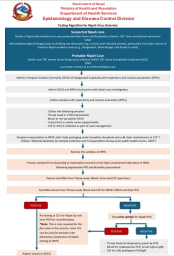
This is an Interim guideline for sample collection and testing Algorithm for Nipah Virus detection in Nepal.
Read More

Jan 1
Flooding in the rural districts of Bagmati Province creates the classic postdisaster conditions for communicable disease transmission: contamination of drinking-water sources, destruction of latrines, displacement of populations into crowded temporary shelters, interruption of health services and cold chain, expansion of vector breeding habitat, and loss of livestock with associated zoonotic exposure. Floods do not import new pathogens; they amplify the pathogens already endemic in the area. Preparedness must therefore be built on what is known to circulate in Bagmati Province — including the enteric pathogens Vibrio cholerae O1, Salmonella Typhi and hepatitis A and E viruses, together with dengue virus, Orientia tsutsugamushi, Leptospira species, Japanese encephalitis virus, measles virus, and residual foci of malaria and visceral leishmaniasis. Two operational realities shape this plan. First, the interval between exposure and detectable clusters is short for enteric disease (2–14 days) and long for vector-borne and leptospiral disease (2–8 weeks), so surveillance intensity must be sustained well beyond the point at which media and political attention recede. Second, the routine surveillance system will be degraded exactly when it is most needed, because reporting health facilities may be damaged, staff displaced and connectivity lost. Apparent declines in reported cases in the first weeks after a flood are more often artefacts of reporting failure than evidence of control.
Read More
Jan 1
Acute Gastro Enteritis was the highest reported condition, accounting for 721 cases.
Read More
Jan 1
Acute Gastro Enteritis was the highest reported condition, accounting for 667 cases.
Read More