Sep 14
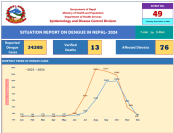
#12 Twelfth Bi-weekly Situation Update on Dengue and Cholere
Read MoreSep 11
#11 Eleventh Bi-weekly situation update on Dengue and Cholera
Read MoreSep 7
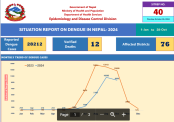
#10 Tenth Bi-weekly situation update on Dengue and Cholera
Read MoreSep 2
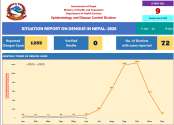
#9 Ninth Bi-weekly situation update on Dengue and Cholera
Read MoreAug 30
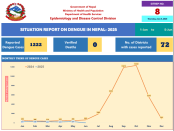
#8 Eighth Bi-weekly situation update Dengue and Cholera
Read MoreAug 28
#7 Seventh Bi-weekly situation update on Dengue and Cholera
Read MoreAug 24
#6 Sixth Bi-weekly situation update on Dengue and Cholera2024__08_23
Read MoreAug 19
#5 FIfth Bi-weekly situation update on Dengue and Cholera 2024_08_19
Read MoreAug 16
#4 Fourth Bi-weekly Situation Update on Dengue and Cholera 2024_08_16
Read MoreAug 16
राष्ट्रिय क्यान्सर नियन्त्रण रणनिती २०२४-२०३० अद्यावधिक
Read MoreMay 5
It is a surveillance case definitions of prioritized infectious diseases.
Read MoreFeb 23
This document presents a structured Rapid Risk Assessment (RRA) conducted at the local level to evaluate public health threats, system readiness, and response capacity. It outlines the methodology used to identify hazards, assess exposure and vulnerability, and determine risk magnitude through qualitative and semi-quantitative scoring. The report analyzes local epidemiological patterns, health system resources, surveillance functionality, and community risk factors. Findings priority hazards, gaps in preparedness, and operational constraints affecting timely detection and response. The document concludes with targeted recommendations to strengthen local preparedness, enhance coordination mechanisms, improve data flow, and build response capacity for future outbreaks and emergencies.
Read MoreFeb 23
This document describes a comprehensive alert and response framework designed to ensure early detection, timely notification, and rapid response to public health events. It defines surveillance structures, reporting pathways, verification procedures, and escalation thresholds across different administrative levels. The framework details roles and responsibilities of health authorities, rapid response teams, laboratories, and coordination bodies. It emphasizes standardized timelines, performance monitoring indicators, and decision-making protocols for outbreak management. The framework aims to improve system efficiency, reduce response delays, and strengthen integrated public health emergency management through clear operational guidance and accountability mechanisms.
Read More